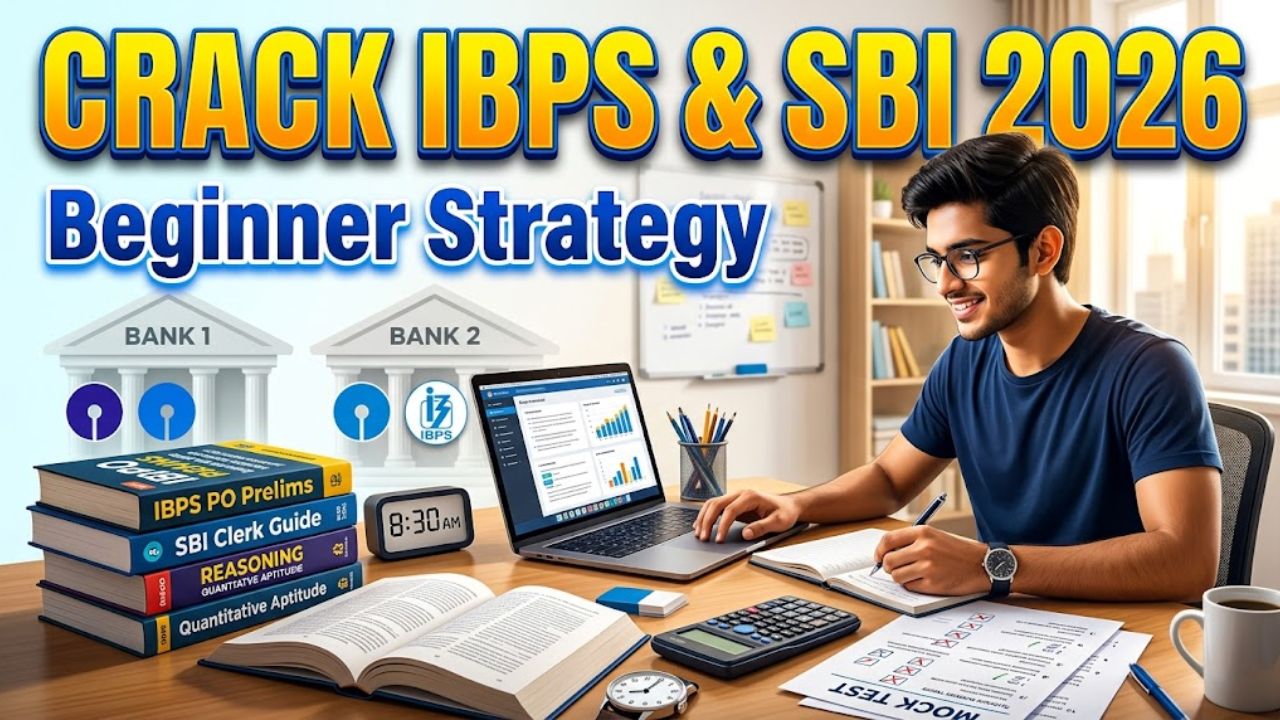
Starting your bank exam journey can feel overwhelming, especially when you are a complete beginner. However, with the right preparation strategy, cracking IBPS or SBI exams is absolutely achievable. Moreover, thousands of students successfully clear these exams every year with smart planning and consistent effort. So, if you are serious about building a stable and rewarding career in banking, this guide will walk you through everything you need to know to get started on the right foot.
Understanding Bank Exams: IBPS and SBI Overview for Beginners
Before diving into preparation, it is important to first understand what these exams actually are. IBPS, which stands for Institute of Banking Personnel Selection, conducts recruitment exams for multiple public sector banks across India. Additionally, SBI, or State Bank of India, conducts its own separate exams for Clerk and Probationary Officer posts. Therefore, knowing the difference between these two bodies will help you choose the right exam based on your goals.
Both exams generally follow a three-stage process: Prelims, Mains, and Interview (for PO posts). Moreover, the Clerk posts typically skip the interview stage, making them slightly more accessible for first-time candidates. Consequently, beginners often start with the Clerk exam to build confidence before attempting the PO level.
| Exam Body | Posts Available | Stages |
|---|---|---|
| IBPS | PO, Clerk, SO, RRB | Prelims, Mains, Interview |
| SBI | PO, Clerk, SO | Prelims, Mains, Interview |
| IBPS Clerk | Clerical Cadre | Prelims, Mains |
| SBI Clerk | Junior Associates | Prelims, Mains |
Complete Bank Exam Syllabus Breakdown You Must Know
Understanding the syllabus is the very first step toward smart preparation. Both IBPS and SBI exams test candidates on five core subjects. These include Quantitative Aptitude, Reasoning Ability, English Language, General Awareness, and Computer Knowledge. Furthermore, the Mains exam adds a deeper level of complexity to each of these sections, so building a strong foundation early is absolutely essential.
In addition, the Quantitative Aptitude section covers topics like simplification, number series, data interpretation, and arithmetic problems. Meanwhile, the Reasoning section tests your logical thinking through puzzles, seating arrangements, syllogisms, and coding-decoding questions. Therefore, consistent daily practice in both these areas can significantly boost your overall score.
On the other hand, the English section focuses on reading comprehension, error detection, fill in the blanks, and vocabulary-based questions. Additionally, General Awareness requires you to stay updated with current affairs, banking news, and static GK topics. Consequently, reading newspapers and following banking news portals daily becomes a non-negotiable habit for serious aspirants.
Bank Exam Preparation Strategy: Building Your Study Plan Step by Step
Now that you understand the syllabus, it is time to build a realistic and effective study plan. First and foremost, assess your current strengths and weaknesses honestly before creating any schedule. Moreover, allocating more time to your weaker subjects in the beginning will give you a more balanced preparation overall.
Ideally, a beginner should dedicate at least 4 to 6 hours of focused study daily. However, quality always matters more than quantity, so avoid mindless reading and focus on active learning instead. Furthermore, divide your day into clear subject-wise slots so that every topic gets adequate attention throughout the week.
Here is a simple weekly study plan that works well for beginners:
| Day | Morning Session | Evening Session |
|---|---|---|
| Monday | Quantitative Aptitude | Reasoning Ability |
| Tuesday | English Language | General Awareness |
| Wednesday | Quantitative Aptitude | Computer Knowledge |
| Thursday | Reasoning Ability | English Language |
| Friday | General Awareness | Mock Test Practice |
| Saturday | Full Length Mock Test | Revision and Analysis |
| Sunday | Weak Area Revision | Current Affairs Review |
Best Books and Resources for IBPS and SBI Exam Preparation
Choosing the right study material is just as important as having a solid plan. Therefore, investing in trusted and widely recommended books from the very beginning will save you a lot of time and confusion. Moreover, avoid the common mistake of collecting too many books, as that often leads to incomplete preparation across multiple resources.
For Quantitative Aptitude, books by R.S. Aggarwal and Arun Sharma are considered the gold standard among banking aspirants. Additionally, for Reasoning Ability, M.K. Pandey and B.S. Sijwali are extremely popular choices among toppers. Furthermore, for English, Wren and Martin for grammar basics combined with SP Bakshi’s book works really well for most beginners.
In addition to books, online platforms like Testbook, Adda247, Oliveboard, and Gradeup offer excellent mock test series and video lectures. Meanwhile, YouTube channels dedicated to bank exam preparation provide free concept-building sessions that are especially helpful for visual learners. Consequently, combining offline books with online resources creates a well-rounded and highly effective preparation approach.
| Subject | Recommended Book | Author |
|---|---|---|
| Quantitative Aptitude | Quantitative Aptitude for Competitive Exams | R.S. Aggarwal |
| Reasoning Ability | A Modern Approach to Verbal Reasoning | R.S. Aggarwal |
| English Language | Objective General English | SP Bakshi |
| General Awareness | Banking Awareness | Arihant Experts |
| Computer Knowledge | Computer Awareness | Arihant Experts |
How to Practice Mock Tests Effectively for Bank Exams
Mock tests are without a doubt the single most powerful tool in your bank exam preparation arsenal. However, simply taking mock tests is not enough; analyzing your performance after each test is where the real improvement happens. Therefore, always spend at least as much time reviewing your mistakes as you do taking the actual test.
Moreover, start taking sectional mock tests in the first month to build speed and accuracy in individual subjects. Subsequently, move on to full-length mock tests once you have covered at least 70 percent of the syllabus. Additionally, aim to take at least 3 to 4 full mock tests every week in the final month before your exam.
Furthermore, track your scores and time management patterns across multiple tests to identify recurring weak areas. Consequently, this data-driven approach will help you fine-tune your strategy and boost your overall percentile significantly. In addition, practicing under real exam conditions, including strict timing and no distractions, will mentally prepare you for exam day pressure.
Time Management Tips During Bank Exam Preparation
Time management is one skill that separates successful candidates from those who fall short. Therefore, learning to manage your time both during preparation and inside the exam hall is absolutely critical. Moreover, each section in bank exams comes with a sectional time limit, which makes it even more important to develop a section-wise time strategy.
During preparation, avoid spending too many hours on a single topic at the cost of others. Instead, follow the Pomodoro technique, which involves studying for 25 minutes and then taking a 5-minute break. Additionally, this technique keeps your mind fresh and significantly improves your retention and focus over long study sessions.
Inside the exam, always attempt your strongest section first to build confidence and save time. Furthermore, never spend more than 30 to 40 seconds on a single question during Prelims. Consequently, skipping tough questions and returning to them later is a smarter strategy that helps you maximize your attempted questions within the given time limit.
General Awareness and Current Affairs Strategy for Banking Exams
General Awareness is one section where many beginners struggle simply because they underestimate how much preparation it requires. However, with a disciplined daily reading habit, you can master this section more easily than any other. Moreover, this section requires less mathematical skill and more consistent reading, making it a high-scoring opportunity for most students.
Therefore, make it a habit to read at least one national newspaper every morning, focusing specifically on economic and financial news. Additionally, follow monthly current affairs capsules from trusted platforms like Adda247 or Gradeup to consolidate your learning. Furthermore, paying special attention to RBI announcements, government schemes, banking mergers, and financial budget highlights will give you a strong edge in this section.
In addition, static GK topics like important banking terms, headquarters of major banks, and financial organizations are frequently asked in both IBPS and SBI exams. Consequently, creating a dedicated notes file for static GK and revising it weekly will ensure you never forget important facts during the actual exam.
Common Mistakes Beginners Make in Bank Exam Preparation
Being aware of common pitfalls is just as important as following the right strategy. Therefore, let us look at the most frequent mistakes that beginners make so you can actively avoid them throughout your preparation journey.
First, many beginners start preparing without a clear plan, which leads to inconsistent and unfocused studying. Moreover, skipping mock tests in the early stages is another major mistake that slows down progress significantly. Additionally, ignoring the English section because it seems easy is a trap that many aspirants fall into, only to struggle with it during the actual exam.
Furthermore, referring to too many books instead of mastering a few good ones is a very common and costly mistake. On the other hand, neglecting current affairs until the last few weeks is another habit that seriously hurts your General Awareness score. Consequently, avoiding these mistakes from day one will give you a much smoother and more productive preparation experience overall.
Motivation and Consistency: The Real Secret to Cracking Bank Exams
Preparation strategy and the right books will only take you so far. However, the real difference between those who crack bank exams and those who do not often comes down to consistency and mental toughness. Therefore, building strong daily habits and maintaining motivation even during tough phases is what will ultimately determine your success.
Moreover, connect with a community of fellow aspirants through online forums, Telegram groups, or local study circles. Additionally, celebrating small wins, like completing a chapter or scoring well on a mock test, keeps your motivation levels high over the long preparation journey. Furthermore, reminding yourself of your career goal and the financial stability a banking job offers will keep you grounded and focused during moments of self-doubt.
In addition, take care of your physical and mental health throughout your preparation. Consequently, regular exercise, adequate sleep, and a balanced diet will directly improve your concentration, memory, and overall exam performance. Therefore, treat your health as an essential part of your bank exam strategy, not just an afterthought.
FAQs
Which is the easiest bank exam for beginners in India?
IBPS Clerk and SBI Clerk are generally considered the most beginner-friendly bank exams in India. They do not have an interview stage and test you on standard topics like Reasoning, English, and Quantitative Aptitude. Therefore, most beginners start with these exams to build confidence before attempting PO-level exams.
How many months of preparation is enough for IBPS or SBI exams?
For a complete beginner, 4 to 6 months of consistent and focused preparation is generally sufficient to crack IBPS or SBI Clerk exams. However, for PO-level exams, 6 to 9 months of dedicated preparation with regular mock tests and revision gives you the best chance of success.
Is coaching necessary for bank exam preparation?
Coaching is not mandatory for cracking bank exams. Moreover, many candidates successfully clear IBPS and SBI exams through self-study using the right books and online platforms. However, if you find it difficult to stay disciplined or need structured guidance, joining a reputed coaching institute or an online course can be very helpful.
How important are mock tests in bank exam preparation?
Mock tests are extremely important and arguably the most critical part of bank exam preparation. They help you improve speed, accuracy, and time management under real exam conditions. Additionally, analyzing your mock test performance regularly helps you identify weak areas and refine your overall strategy before the actual exam.
What is the best time to start preparing for bank exams?
The best time to start is as early as possible, ideally right after completing your graduation or even during your final year. However, it is never too late to begin. Moreover, starting your preparation at least 5 to 6 months before the exam notification gives you ample time to cover the syllabus, practice mock tests, and revise thoroughly.
SEE ALSO: How to Crack a Government Job in 6 Months (Realistic Plan 2026 Guide)