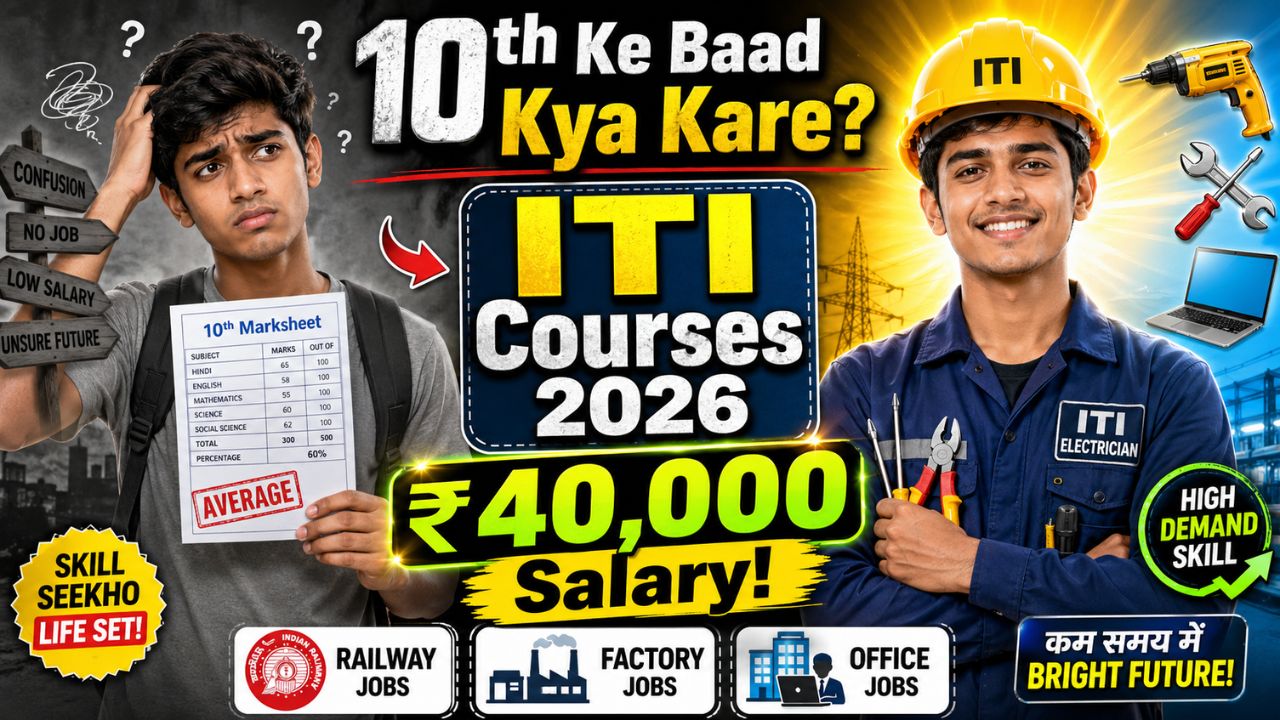
Just passed your 10th boards and wondering what’s next? You are not alone. Thousands of students across India face this exact crossroads every year. The good news is that ITI courses after 10th with the highest salary are now more rewarding than ever before. In 2026, skilled ITI professionals are landing jobs in Railways, BHEL, NTPC, Defence, and top private companies. Moreover, these courses are short, affordable, and deeply practical. So if you want a stable, high-paying career without spending years in college, ITI might just be your smartest move.
What is ITI and Why Should You Consider It After 10th?
ITI stands for Industrial Training Institute. The Government of India established these institutes back in 1950, and today they operate under the Directorate General of Training (DGT), which falls under the Ministry of Skill Development and Entrepreneurship. In simple terms, ITI is a government-backed vocational training system that teaches you real-world skills in a short time.
Moreover, ITI courses focus on practical training rather than just theory. So instead of sitting in classrooms for hours, you actually work with tools, machines, and real industrial equipment. This hands-on approach makes you job-ready much faster than most traditional degree programs.
Additionally, ITI certificates carry national recognition. When you complete an ITI course and clear the trade test, you receive a National Trade Certificate (NTC) issued by NCVT (National Council for Vocational Training). This certificate is valid across India and opens doors to both government and private sector jobs. Furthermore, it is also recognized in several countries abroad, especially in the Gulf and Southeast Asia, where skilled workers are always in high demand.
ITI Courses After 10th: Eligibility and Admission Process
Before you start planning, it helps to understand who can actually apply. The eligibility is simple and straightforward. You must have passed your Class 10 examination from a recognized board. Some specific trades may require basic knowledge of Science or Mathematics. Additionally, the minimum age for ITI admission is 14 years, and there is generally no upper age limit for most trades.
In terms of admission, most states conduct merit-based counselling using your Class 10 marks. However, some states also hold state-level entrance exams. Therefore, it is always a good idea to check the official website of your state’s Directorate of Technical Education well in advance. You can also visit the NCVT MIS portal and the DGET (Directorate General of Employment and Training) website for updated information.
Furthermore, government ITI fees are extremely affordable. For engineering trades, fees typically range between Rs. 1,000 and Rs. 9,000 per year. For non-engineering trades, the range goes from Rs. 3,950 to Rs. 7,000 per year. Consequently, even students from economically weaker sections can access quality technical training without financial burden. In many states, SC and ST students receive free education with government support.
Top ITI Courses After 10th with Highest Salary in 2026
Now, let’s get to the most important part. Which ITI courses actually pay the best? Below are the top trades that offer the strongest salary potential, widest job scope, and best long-term career growth in 2026.
ITI Electrician Course: The Most In-Demand Trade
Without any doubt, the Electrician trade is the most popular and financially rewarding ITI course after 10th. The course runs for 2 years and covers electrical wiring, motor winding, transformer repair, installation, circuit testing, and safety protocols. Additionally, it trains you for both residential and industrial electrical work.
Moreover, as India continues to invest heavily in infrastructure, renewable energy, and smart cities, the demand for skilled electricians keeps rising every year. You can find jobs in power plants, construction companies, railways, state electricity boards, and private industries. Furthermore, government jobs for electricians in organizations like NTPC, BHEL, and Indian Railways offer salaries between Rs. 22,000 and Rs. 40,000 per month. In private companies, freshers typically start at Rs. 12,000 to Rs. 18,000 per month, and experienced electricians earn significantly more.
| Feature | Details |
|---|---|
| Duration | 2 Years |
| Eligibility | 10th Pass (Science & Math preferred) |
| Fresher Salary (Private) | Rs. 12,000 to Rs. 18,000/month |
| Government Job Salary | Rs. 25,000 to Rs. 40,000/month |
| Top Recruiters | Railways, NTPC, BHEL, State Electricity Boards |
ITI Fitter Course: A Pillar of the Manufacturing Sector
The ITI Fitter course is another top-paying trade that every 10th pass student should seriously consider. This 2-year course trains you to assemble, maintain, and repair machinery used in factories, power plants, and industrial units. Additionally, fitters work with precision tools, measuring instruments, and heavy engineering equipment.
Furthermore, the Fitter trade has an enormous scope in India’s growing manufacturing sector. Big companies like BHEL, TATA Motors, Ashok Leyland, and Hero MotoCorp regularly recruit ITI Fitter graduates. Moreover, government organizations including Indian Railways, DRDO, ISRO, and SAIL also hire fitters every year. The starting salary for an ITI Fitter in a private company ranges from Rs. 12,000 to Rs. 20,000 per month. In government jobs, however, the pay goes up to Rs. 25,000 to Rs. 45,000 per month with added allowances and benefits.
| Feature | Details |
|---|---|
| Duration | 2 Years |
| Eligibility | 10th Pass |
| Fresher Salary (Private) | Rs. 12,000 to Rs. 20,000/month |
| Government Job Salary | Rs. 25,000 to Rs. 45,000/month |
| Top Recruiters | BHEL, TATA Motors, Railways, SAIL, ISRO |
ITI Mechanic (Motor Vehicle) Course: Ride the Automobile Boom
India’s automobile industry is one of the fastest growing in the world. Consequently, skilled motor vehicle mechanics are in extremely high demand right now. The ITI Mechanic (Motor Vehicle) course, commonly called MMV, runs for 2 years and teaches you how to diagnose, repair, and maintain cars, trucks, bikes, and other vehicles. Additionally, it covers engine overhaul, fuel systems, brake systems, and electrical components of modern vehicles.
Moreover, with the rise of electric vehicles (EVs) across India, there is now a brand new branch of this trade focused specifically on EV mechanics and battery systems. So if you choose this course today, you position yourself perfectly for the future of transportation. Companies like Hero MotoCorp, TATA Motors, Maruti Suzuki, Hyundai, and Mahindra regularly hire ITI MMV graduates. Furthermore, you can also start your own automobile repair workshop after gaining a few years of experience, which is a great path to self-employment.
| Feature | Details |
|---|---|
| Duration | 2 Years |
| Eligibility | 10th Pass |
| Fresher Salary | Rs. 12,000 to Rs. 20,000/month |
| Experienced Salary | Rs. 30,000 to Rs. 50,000/month |
| Top Recruiters | Maruti, Hyundai, TATA Motors, Hero MotoCorp |
ITI COPA Course: Best ITI Course for the Digital Age
COPA stands for Computer Operator and Programming Assistant. This is hands down the best ITI course for students who love computers and want to work in offices, IT companies, or the digital space. Moreover, the COPA course runs for just 1 year, making it one of the quickest ways to enter the workforce after 10th.
The course covers computer hardware, software, database management, MS Office, data entry, email communication, internet usage, and basic programming. Additionally, it also includes training in desktop publishing tools like CorelDRAW and Adobe PageMaker. Therefore, COPA graduates can work in banks, government offices, private companies, BPO firms, and even start their own computer training centres.
Furthermore, with India’s ongoing digital transformation and increasing demand for data entry operators, office assistants, and computer operators, COPA has become one of the most relevant ITI trades in 2026. The starting salary for a COPA graduate typically ranges from Rs. 10,000 to Rs. 15,000 per month. However, with additional skills and experience, it can rise significantly.
| Feature | Details |
|---|---|
| Duration | 1 Year |
| Eligibility | 10th Pass |
| Fresher Salary | Rs. 10,000 to Rs. 15,000/month |
| Course Fee | Rs. 5,000 to Rs. 25,000 per year |
| Top Recruiters | Banks, BPOs, Govt Offices, IT Companies |
ITI Welder Course: A Skill With Global Demand
Welding is one of those core industrial skills that never goes out of demand. The ITI Welder course is typically 1 year long and teaches you arc welding, gas welding, MIG/TIG welding, and related safety practices. Moreover, welders work in shipbuilding, construction, oil and gas, railways, and heavy manufacturing sectors.
Additionally, the welding trade offers excellent overseas job opportunities, particularly in the Gulf countries, where Indian ITI welders are highly valued. Consequently, experienced welders working abroad can earn significantly more than their counterparts in India. In India, the average monthly pay for a welder starts at around Rs. 12,000 to Rs. 15,000 and can go higher with skill and experience. Furthermore, organizations like BHEL, DRDO, and Indian Railways regularly recruit welders through competitive processes.
| Feature | Details |
|---|---|
| Duration | 1 Year |
| Eligibility | 10th Pass |
| Average Salary | Rs. 12,000 to Rs. 20,000/month |
| Abroad Scope | Gulf countries, high demand |
| Top Recruiters | BHEL, DRDO, Railways, Shipbuilding firms |
ITI RAC Mechanic Course: Cool Career in Refrigeration and AC
The RAC (Refrigeration and Air Conditioning) Mechanic course is rapidly gaining popularity, and for a very good reason. As temperatures rise and air conditioning becomes a necessity across India, skilled RAC technicians are finding more work than ever before. Moreover, this 2-year course trains you to install, service, and repair air conditioners, refrigerators, cold storage units, and industrial cooling systems.
Additionally, RAC mechanics can easily start their own repair and maintenance service business, which offers excellent self-employment income. Furthermore, with growing infrastructure, commercial buildings, hospitals, and industries all requiring climate control systems, the scope of this trade keeps expanding every year. The monthly earning for a trained RAC mechanic starts around Rs. 15,000 and can go well above Rs. 35,000 with experience and clientele.
ITI Draughtsman (Civil) Course: Build Your Career in Construction
If you have an interest in construction and architecture, the ITI Draughtsman Civil course is a perfect fit. This course teaches you how to create blueprints, technical drawings, and construction plans using both hand drafting and computer-aided design (CAD) tools. Moreover, draughtsmen work on roads, bridges, tunnels, buildings, and other civil engineering projects.
The duration of this course is typically 2 years, and you can find jobs in government departments, construction firms, and private engineering companies. Additionally, the annual package for a successful draughtsman can go up to Rs. 3 lakhs or more, depending on the employer and project scale. Furthermore, with India’s massive infrastructure push under various national development programmes, this trade has excellent long-term scope.
ITI Instrument Mechanic: The Highest-Paying Niche Trade
The Instrument Mechanic trade is a specialized 2-year course that focuses on industrial instruments, control systems, and automation used in large-scale industries like oil refineries, gas plants, and petrochemical industries. Moreover, while the number of available jobs is fewer compared to common trades like Electrician or Fitter, the salary is considerably higher.
Beginners in this trade earn around Rs. 12,000 to Rs. 20,000 per month. However, experienced Instrument Mechanics can earn Rs. 40,000 to Rs. 70,000 or even more per month. Consequently, this trade is ideal for students who enjoy precision technical work and want to specialize in a niche industrial field with excellent earning potential.
Government Jobs Available for ITI Graduates in 2026
One of the biggest advantages of completing an ITI course is direct access to government sector jobs. Moreover, these jobs offer job security, fixed working hours, pension benefits, and competitive pay packages. Below are the top government and PSU recruiters for ITI graduates:
| Organization | Job Roles | Monthly Salary |
|---|---|---|
| Indian Railways | Technician, ALP, Fitter, Electrician | Rs. 25,000 to Rs. 45,000 |
| BHEL | Technician Apprentice | Rs. 20,000 to Rs. 35,000 |
| NTPC | Electrician, Fitter | Rs. 22,000 to Rs. 40,000 |
| SAIL | Trainee Technician | Rs. 20,000 to Rs. 35,000 |
| Defence (Army/Navy/Air Force) | Tradesman, Mechanic, Welder | Rs. 25,000 to Rs. 45,000 |
| DRDO | Apprentice in various trades | Rs. 9,000 to Rs. 12,000 (training) |
| State Electricity Boards | Lineman, Electrician | Rs. 18,000 to Rs. 30,000 |
Furthermore, after completing your ITI, you can also enroll in the National Apprenticeship Promotion Scheme (NAPS), which connects ITI graduates with industries for paid apprenticeships. This gives you hands-on industry experience while earning a monthly stipend at the same time.
ITI After 10th: Engineering vs Non-Engineering Trades Compared
ITI courses fall into two broad categories. Engineering trades focus on technical subjects like electricity, mechanics, fabrication, and civil work. Non-engineering trades, on the other hand, cover areas like computer operation, stenography, dress making, and hospitality. Both categories have their own career paths and earning potential. Moreover, you should choose based on your interests and long-term career goals.
| Type | Popular Trades | Duration | Average Salary |
|---|---|---|---|
| Engineering | Electrician, Fitter, Welder, Mechanic | 1 to 2 Years | Rs. 15,000 to Rs. 45,000/month |
| Non-Engineering | COPA, Stenography, Dress Making | 6 months to 1 Year | Rs. 10,000 to Rs. 25,000/month |
What Can You Do After Completing an ITI Course?
Completing an ITI course does not limit you to just one path. In fact, it opens multiple doors at the same time. First, you can directly join the private sector and start earning. Additionally, you can appear for government recruitment exams conducted by Railways, SSC, BHEL, NTPC, and Defence forces. Moreover, you can enroll in an apprenticeship program under NAPS to gain real industry experience with a monthly stipend.
Furthermore, if you want to continue your education, you can pursue a Diploma after ITI through lateral entry. This means you directly join the second year of a diploma program, saving one full year of study. Consequently, you can later even pursue a degree in engineering through lateral entry into B.Tech programs. So the ITI path is not a dead-end at all. Instead, it is a launchpad that you can take in whichever direction suits you best.
Tips to Choose the Right ITI Course for Your Career
Choosing the right ITI course is probably the most important step of this entire journey. Therefore, you should think carefully before making a decision. First, identify your interests clearly. If you enjoy working with electrical systems, go for the Electrician trade. If you prefer computers and office work, COPA is the better choice. Moreover, if you want to work abroad or start your own business, trades like Welder, RAC Mechanic, or Motor Vehicle Mechanic give you that flexibility.
Additionally, research the job market in your state and region. Some trades may have higher local demand depending on the industries in your area. Furthermore, always try to visit the ITI campus before enrolling and talk to current students or alumni to get an honest picture. Also, aim for NCVT-certified institutes over SCVT, because NCVT certificates are nationally recognized and carry more weight with employers across India and abroad.
FAQs
Which ITI course has the highest salary after 10th?
Electrician, Fitter, Instrument Mechanic, and RAC Technician are among the highest-paying ITI courses after 10th in 2026.
What is the salary after completing an ITI course?
Freshers earn around ₹10,000 to ₹20,000 per month, while experienced professionals can earn ₹40,000+ depending on the trade.
Can I get a government job after ITI?
Yes, ITI graduates can apply for jobs in Railways, NTPC, BHEL, Defence, and other government sectors.
Which ITI course is best for future demand?
Electrician, COPA, Mechanic (Motor Vehicle), and RAC Technician have strong future demand due to industrial and digital growth.
Is ITI better than a diploma after 10th?
ITI is faster and skill-based, while diploma offers deeper technical knowledge. ITI is better for quick job entry.
SEE ALSO: