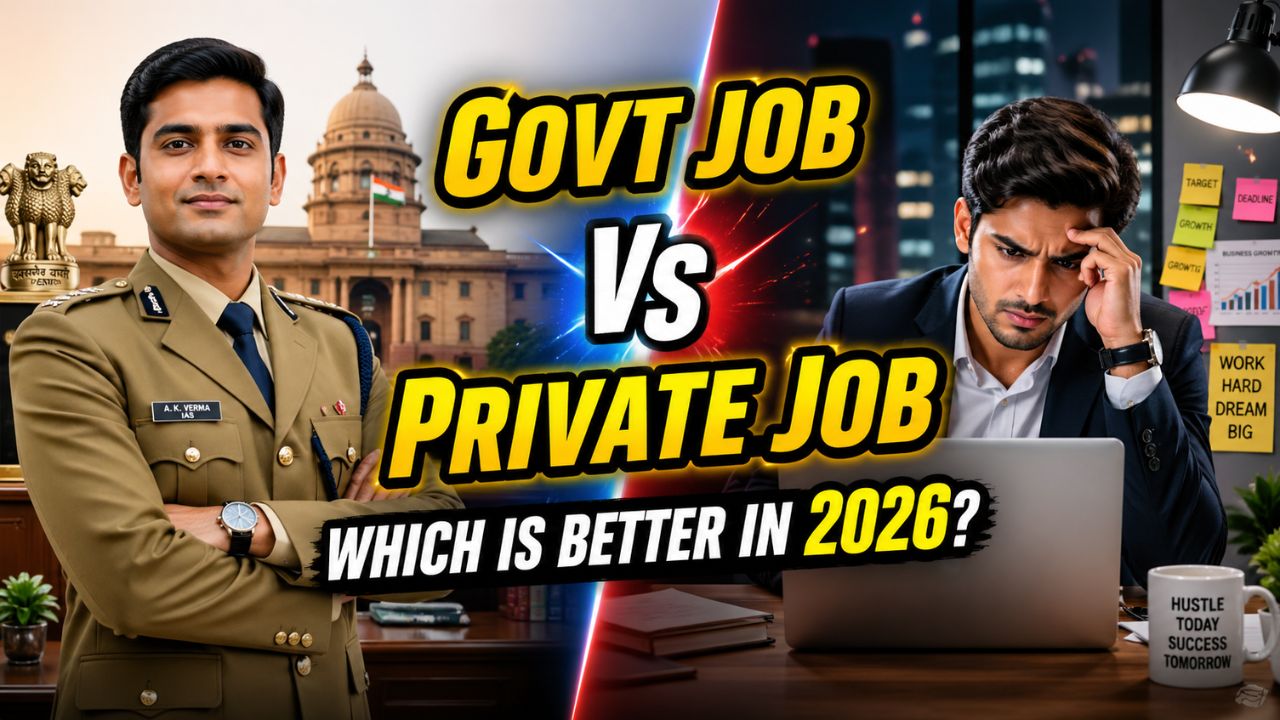
Choosing between a government job and a private job is one of the biggest career decisions you will ever make. In 2026, both sectors offer great opportunities, but they come with very different lifestyles, salaries, and growth paths. So, which one is actually better for you? Well, the answer depends on your personality, goals, and priorities. In this article, we break down everything you need to know, from job security and salary to work culture and future growth, so you can make a smart, confident career choice.
Government Job vs Private Job: A Quick Overview
Before we jump into the details, it is important to understand what each sector truly offers. Government jobs are positions offered by central, state, or local government bodies. These include roles in banking, defence, railways, teaching, civil services, and more. Private jobs, on the other hand, are offered by privately owned companies, startups, MNCs, and corporations across industries like IT, finance, marketing, and retail.
Moreover, both sectors have evolved significantly in recent years. Government departments are now more tech-driven and efficient, while private companies are offering better work-life balance policies than before. So, comparing them in 2026 requires a fresh perspective rather than relying on old stereotypes.
Job Security: Government Job Wins Here
One of the biggest reasons people prefer government jobs is job security. In a government role, you are almost never at risk of sudden layoffs or retrenchment. Additionally, even during economic downturns, recessions, or global crises like we saw in recent years, government employees kept receiving their salaries without interruption.
In contrast, private sector jobs can be unpredictable. Companies downsize, restructure, or shut down due to market pressures. Consequently, many private employees have faced sudden job losses, especially in sectors like IT, media, and retail. However, it is also true that skilled private sector employees with strong portfolios rarely stay unemployed for long.
Therefore, if job security is your top priority, a government job clearly has the upper hand. But if you are confident in your skills and adaptable to change, private jobs can still offer a very stable career path.
Salary and Perks: A Detailed Comparison
Salary is where things get interesting. In the private sector, high performers can earn significantly more than their government counterparts, especially in fields like software engineering, finance, consulting, and management. Meanwhile, entry-level government salaries may seem modest, but they come with a powerful package of benefits.
| Feature | Government Job | Private Job |
|---|---|---|
| Starting Salary | Moderate but fixed | Varies widely by industry |
| Salary Growth | Slow but steady | Fast for high performers |
| Pension | Yes (in most cases) | Rarely offered |
| Medical Benefits | Full family coverage | Basic to good coverage |
| House Rent Allowance | Yes (HRA included) | Sometimes included |
| Bonuses | Fixed annual bonus | Performance-based, higher potential |
| Provident Fund | Yes, with government contribution | Yes, but varies by company |
| Job Perks | Quarters, travel allowance, LTA | Cab, food, insurance, stock options |
Additionally, government employees benefit from the 7th Pay Commission recommendations in India, which have significantly improved their pay structure. In addition, perks like government housing, free medical treatment, and pension after retirement make the total compensation package very attractive over the long term.
On the other hand, a senior software engineer or product manager at a top private firm can easily earn five to ten times more than a similarly experienced government officer. So, if maximising your income is the goal, private jobs offer a much faster route.
Work-Life Balance: Which Sector Treats You Better?
Work-life balance is a growing concern for professionals in 2026. Government jobs generally follow fixed working hours, mostly from 9 AM to 5 PM, with weekends off and a generous number of public holidays. Moreover, government employees enjoy long leaves, including earned leave, casual leave, and medical leave, which private employees often cannot access so freely.
However, the private sector has also made impressive strides in this area. Many top companies now offer remote work, flexible hours, mental health days, and hybrid work models. Consequently, a well-chosen private job at a progressive company can offer just as much balance as a government role, sometimes even more.
That said, high-pressure private jobs, especially in investment banking, consulting, or early-stage startups, can demand 10 to 14 hours of work daily. Therefore, the work-life balance in the private sector depends heavily on the company you join and the role you take on.
Career Growth and Promotions: Private Jobs Lead the Race
If you are ambitious and want to climb the ladder quickly, private jobs are generally better. In a private company, your performance directly drives your growth. Additionally, you can switch companies, negotiate higher salaries, and reach senior positions within just a few years if you perform well.
In contrast, government promotions are usually time-bound and seniority-based. Even if you are exceptionally talented, you may have to wait years before getting a promotion. However, recent reforms in some government departments are slowly linking performance to growth, which is a positive development.
Moreover, private jobs expose you to diverse projects, global clients, and cutting-edge technologies, which sharpen your skills much faster. In addition, certifications, side projects, and networking can accelerate your private sector career in ways that are simply not possible in a government setup.
Social Status and Respect: Still a Factor in India
In India, a government job still carries tremendous social prestige, especially in smaller cities and towns. Families often prefer their children to secure a government position because of its stability and the respect it commands in society. Moreover, positions like IAS, IPS, IFS, or jobs in public sector banks are considered highly prestigious and are seen as marks of achievement.
However, this mindset is gradually changing in urban areas. Today, a successful entrepreneur, a senior manager at an MNC, or a tech professional at a global firm also commands significant respect. Consequently, social status is no longer a one-sided argument in favour of government jobs, particularly among younger, educated urban populations.
Stress Levels and Work Pressure: Know What You Are Signing Up For
Stress is a major factor that many people overlook when comparing these two career paths. Government jobs are generally less stressful in terms of daily targets, performance pressure, and deadlines. However, they can sometimes be mentally draining due to bureaucratic processes, slow decision-making, and limited room for creativity.
Private jobs, on the other hand, often come with high expectations, tight deadlines, and constant performance reviews. Therefore, they can be more stressful on a day-to-day basis. However, many professionals find this pressure motivating and energising. In addition, the sense of achievement when you hit targets or complete projects can be deeply satisfying.
Which Is Better for Women in 2026?
For women in India, government jobs have traditionally been the preferred choice, and for good reasons. They offer maternity leave, job security, fixed hours, and a safer working environment in many cases. Moreover, government policies actively promote gender equality in public sector hiring through reservation and recruitment drives.
However, many progressive private companies in 2026 also offer excellent maternity benefits, creche facilities, anti-harassment policies, and flexible work options. Consequently, women today have strong career opportunities in both sectors. The choice ultimately depends on the individual’s personal goals, family situation, and career aspirations.
Government Job vs Private Job: Side-by-Side Comparison
| Criteria | Government Job | Private Job |
|---|---|---|
| Job Security | Very High | Moderate to High |
| Salary Potential | Moderate | Very High |
| Work-Life Balance | Excellent | Varies by company |
| Career Growth Speed | Slow | Fast |
| Pension Benefits | Yes | Rarely |
| Creativity and Innovation | Limited | High |
| Social Status in India | Very High | Growing rapidly |
| Work Pressure | Low to Moderate | Moderate to High |
| Skill Development | Moderate | Very High |
| Flexibility | Low | High (in many companies) |
How to Decide Which Path Is Right for You
Ultimately, the best career path depends on who you are and what you truly want from life. If you value stability, fixed hours, social respect, and long-term financial security through pension and benefits, a government job is clearly the better choice for you. Moreover, if you have family responsibilities and prefer a predictable routine, the government sector will support that lifestyle very well.
On the other hand, if you are driven by ambition, love fast-paced environments, want to earn more money quickly, and enjoy constant learning and skill-building, a private job is the right fit. Additionally, if you dream of rising to a leadership position or even starting your own business someday, the private sector gives you the experience, exposure, and network to make that happen.
Therefore, instead of asking which is universally better, ask yourself which one aligns with your personal values, lifestyle, and long-term goals. That honest self-assessment will lead you to the right answer every time.
Final Thoughts
In 2026, both government and private jobs offer unique advantages that can lead to a fulfilling and successful career. Neither sector is perfect, and both come with their own set of trade-offs. However, with the right mindset, preparation, and clarity about your goals, you can thrive in either path. So, take your time, evaluate your priorities honestly, and choose the career that truly makes you happy, not just the one that looks good on paper.
Which is better in 2026, a government job or a private job?
Both have their own strengths. Government jobs offer better job security, pension, and work-life balance. Private jobs offer higher salaries, faster growth, and more skill development. The better choice depends entirely on your personal goals and lifestyle preferences.
Do government employees earn less than private employees?
At the entry level, government salaries may be lower than top private sector roles. However, when you factor in perks like pension, housing allowance, medical benefits, and job security, the overall package becomes very competitive over a full career span.
Is a government job better for women in India?
Government jobs are traditionally preferred by women due to fixed hours, maternity benefits, and job security. However, many progressive private companies in 2026 also offer excellent support for women, so both sectors can be great depending on the employer.
Can I switch from a government job to a private job?
Yes, you can switch, though it requires proper resignation procedures and sometimes a notice period. Many professionals do make this transition, especially when they want faster career growth or higher salaries. Planning the switch carefully is very important.
Which sector offers better skill development opportunities?
Private sector jobs generally offer faster and broader skill development due to exposure to diverse projects, technologies, and global work environments. Government jobs, however, are also improving in this area with digital initiatives and training programs in recent years.
SEE ALSO:
- How to Crack a Government Job in 6 Months (Realistic Plan 2026 Guide)
- Bank Exam Preparation Strategy 2026: Crack IBPS & SBI for Beginners
- Government Jobs After 12th Pass 2026: Complete List, Salary, Exams & Best Career Options
- Best Government Jobs for Women in India 2026: High Salary, Eligibility & Top Career Options