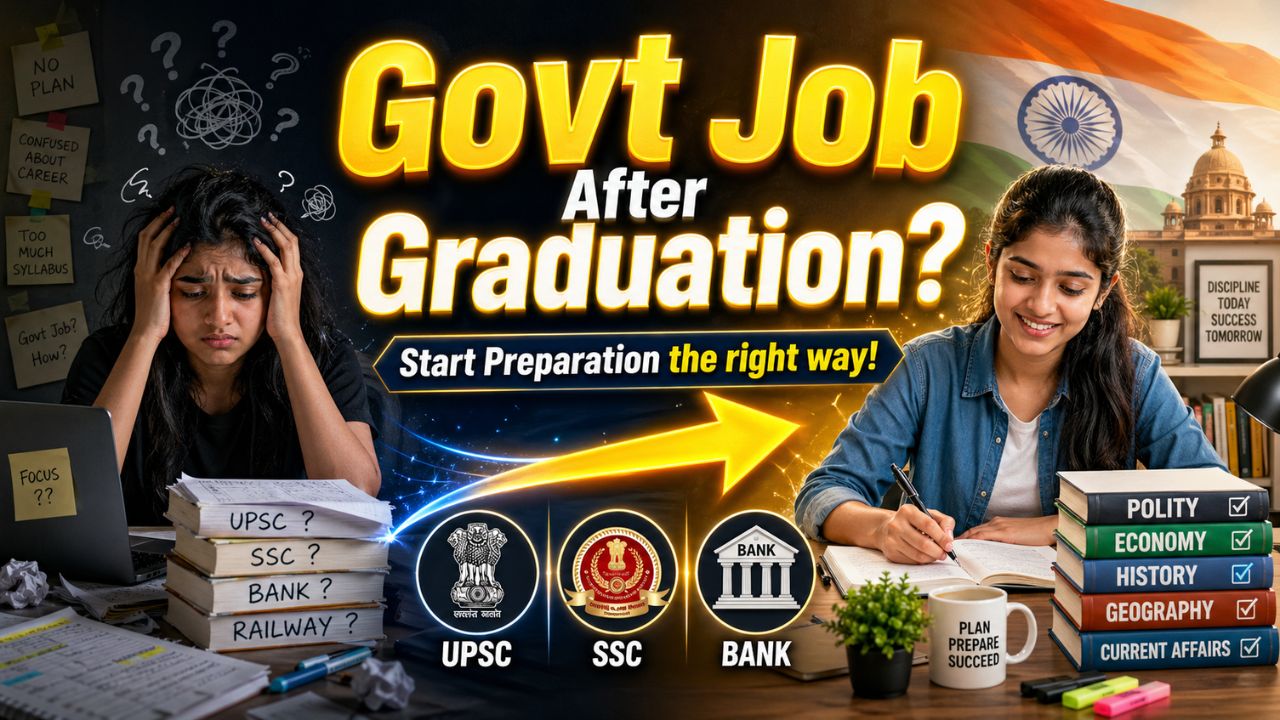
So, you’ve finally finished your graduation and now you’re thinking about government jobs. Honestly, that’s one of the smartest decisions you can make right now. A government job in India offers job security, a decent salary, pension benefits, and social respect that very few private jobs can match. But here’s the thing: most fresh graduates have absolutely no idea where to begin. They feel lost, confused, and overwhelmed by the sheer number of exams, subjects, and coaching options out there. If that sounds like you, don’t worry. This guide will walk you through every step of starting your government job preparation after graduation, so you can build a clear roadmap and move forward with confidence.
Why Government Jobs Are Worth Pursuing After Graduation
Before jumping into preparation tips, it’s important to understand why so many graduates choose this path every year. Government jobs offer unmatched stability in a world where private companies lay off employees without warning. Moreover, perks like paid leaves, medical benefits, housing allowances, and a fixed pension after retirement make these jobs incredibly attractive. In addition, the social status that comes with being an IAS officer, a bank PO, or an SSC CGL qualifier is something that genuinely matters in Indian society. Therefore, if you are serious about your future, investing your time and energy into government job preparation right after graduation is absolutely the right move.
Understanding the Government Job Landscape in India
First of all, you need to understand that government jobs in India fall into several broad categories. These include central government jobs, state government jobs, public sector undertakings (PSUs), banking sector jobs, defence jobs, and teaching positions. Each category has its own conducting body, exam pattern, and eligibility criteria. For example, UPSC conducts the Civil Services Exam for IAS, IPS, and IFS positions. Meanwhile, SSC conducts exams like CGL, CHSL, and MTS for various central government posts. On the other hand, IBPS and SBI conduct exams for bank PO and clerk positions. Additionally, state public service commissions conduct their own exams for state-level administrative roles. So, understanding this landscape clearly is your very first step.
| Exam Category | Conducting Body | Popular Posts |
|---|---|---|
| Civil Services | UPSC | IAS, IPS, IFS |
| Staff Selection | SSC | CGL, CHSL, MTS |
| Banking | IBPS / SBI | PO, Clerk, SO |
| Railways | RRB | NTPC, Group D, JE |
| State Level | State PSC | SDM, BDO, Naib Tehsildar |
| Defence | UPSC / SSB | NDA, CDS, AFCAT |
| Teaching | CTET / State TET | Primary and Secondary Teachers |
How to Choose the Right Government Exam After Graduation
Choosing the right exam is honestly the most critical decision you will make at this stage. Therefore, do not rush this step. Start by evaluating your own strengths, interests, and academic background. For instance, if you have a commerce or finance background, banking exams like IBPS PO or SBI PO might suit you perfectly. On the other hand, if you are passionate about administration and public service, UPSC Civil Services or State PSC exams are the right fit. Additionally, if you prefer a faster result with less preparation time, SSC CGL or RRB NTPC can be excellent starting points. Consequently, matching your strengths with the right exam saves you years of misdirected effort.
Creating a Realistic Study Plan for Government Job Preparation
Once you have chosen your target exam, the next step is building a study plan that actually works. However, most students make the mistake of creating overly ambitious schedules that fall apart within a week. Instead, build a realistic plan that fits your daily routine. Start by dividing your day into focused study blocks of 2 to 3 hours each. Moreover, prioritize subjects based on the exam syllabus and give more time to topics that carry higher marks. For example, in SSC CGL, General Awareness and Quantitative Aptitude together carry significant weight. Therefore, spending extra hours on these sections makes logical sense. Additionally, always keep one hour daily for revision so that previously studied topics stay fresh in your memory.
| Time Slot | Activity |
|---|---|
| 6:00 AM to 8:00 AM | Current Affairs and News Reading |
| 9:00 AM to 12:00 PM | Core Subject Study (Maths, Reasoning, GK) |
| 2:00 PM to 4:00 PM | English and Descriptive Writing Practice |
| 5:00 PM to 6:00 PM | Previous Year Paper Practice |
| 8:00 PM to 9:00 PM | Revision and Notes Making |
Best Study Resources and Books for Government Exam Preparation
Choosing the right study material can make or break your preparation. Moreover, the market is flooded with books and online courses, which makes selection even more confusing. However, sticking to a few trusted and well-tested resources is always better than jumping between too many books. For General Knowledge and Current Affairs, reading a daily newspaper like The Hindu or Hindustan Times is absolutely essential. Additionally, books like Lucent’s General Knowledge and Manorama Yearbook are trusted by toppers across all exams. For Quantitative Aptitude, R.S. Aggarwal’s book remains a timeless resource. Meanwhile, for Reasoning, M.K. Pandey’s Analytical Reasoning is highly recommended. In addition, platforms like Testbook, Unacademy, and BYJU’s Exam Prep offer structured online courses with mock tests that closely mirror actual exam patterns.
The Role of Mock Tests and Previous Year Papers
Practicing mock tests and previous year question papers is honestly one of the most powerful strategies in government job preparation. Many students study theory for months but never practice under real exam conditions. Consequently, they struggle with time management during the actual exam. Therefore, start solving previous year papers at least 3 to 4 months before your exam date. Moreover, take full-length mock tests every week and analyze your performance honestly. Additionally, identify the topics where you consistently lose marks and dedicate extra revision time to those areas. In addition, practicing mock tests builds exam temperament, reduces anxiety, and improves your overall speed and accuracy significantly.
Should You Join Coaching or Study Self-Study for Government Exams
This is one of the most common questions fresh graduates ask, and the honest answer is: it depends entirely on your situation. Coaching institutes like Vajiram and Ravi, Vision IAS, or Paramount Coaching can provide structured guidance, peer competition, and experienced mentors. However, coaching is expensive and not necessary for everyone. Many successful candidates have cleared UPSC, SSC, and banking exams purely through self-study using the right books and online resources. Therefore, if you are disciplined and self-motivated, self-study combined with quality online platforms is more than enough. On the other hand, if you need structure and regular accountability, joining a reputed coaching institute can genuinely help. Additionally, hybrid models where you take specific online courses for weak subjects while studying independently for strong ones work extremely well for most students.
Managing Time and Staying Consistent During Preparation
Consistency is honestly the single biggest factor that separates successful candidates from those who keep failing. Moreover, government exam preparation is not a sprint but a long-distance marathon. Therefore, building small but powerful daily habits matters far more than occasional bursts of intense studying. For instance, reading current affairs for just 30 minutes every morning adds up to over 180 hours of knowledge building in a year. Additionally, avoid the trap of studying 12 hours one day and nothing the next. Instead, aim for a steady 6 to 8 hours of focused study daily. Meanwhile, take short breaks between study sessions to keep your mind fresh and focused. Consequently, this kind of balanced approach keeps your motivation high over months of preparation.
Dealing With Failures and Staying Mentally Strong
Let’s be real: government exam preparation is mentally tough, and failures are part of the journey for almost every candidate. In fact, many IAS officers cleared the exam on their second or third attempt. Therefore, experiencing failure once or twice does not mean you are not cut out for this path. However, the way you respond to failure defines your future. Instead of giving up, analyze what went wrong and fix it in the next attempt. Moreover, surrounding yourself with positive and motivated peers can genuinely lift your spirits during tough phases. Additionally, taking care of your physical health through regular exercise, proper sleep, and good nutrition directly improves your mental focus and study performance. So, treat your mental health as seriously as your study schedule.
Important Tips to Boost Your Government Job Preparation
Here are some additional practical tips that toppers swear by and that can genuinely speed up your progress. First, always study from official notifications and syllabus documents published by the conducting bodies. Moreover, never rely on rumors or unverified sources for exam updates. Second, make short and clean handwritten notes for quick revision before the exam. Additionally, follow reliable YouTube channels and Telegram groups specifically dedicated to your target exam for daily updates and free study material. Third, stay updated with monthly current affairs magazines like Pratiyogita Darpan or Competition Success Review. Furthermore, practice answer writing regularly if you are targeting descriptive exams like UPSC or State PSC. Consequently, all these small habits compound over time and give you a serious edge over other candidates.
| Preparation Tip | Why It Matters |
|---|---|
| Read daily newspaper | Builds current affairs knowledge |
| Solve mock tests weekly | Improves speed and accuracy |
| Make short revision notes | Helps during last-minute revision |
| Follow official syllabus | Avoids studying irrelevant topics |
| Stay physically active | Improves concentration and memory |
| Join study groups | Keeps motivation and accountability high |
Final Thoughts on Starting Government Job Preparation After Graduation
Starting your government job preparation right after graduation is genuinely one of the best career decisions you can make. However, success in this field does not come from hard work alone. It comes from smart work, the right strategy, consistent effort, and a never-give-up mindset. Therefore, choose your exam wisely, build a practical study plan, use trusted resources, practice mock tests regularly, and take care of your mental health throughout the journey. Moreover, remember that thousands of candidates clear these exams every year, and there is absolutely no reason why you cannot be one of them. So, start today, stay consistent, and trust the process. Your government job is closer than you think.
FAQs
Which government exam is best to attempt right after graduation?
SSC CGL, IBPS PO, and RRB NTPC are considered the best government exams to start with right after graduation. These exams have a clear syllabus, structured preparation path, and offer good career growth opportunities in central government departments and banking sectors.
How many hours should I study daily for government exam preparation?
Ideally, 6 to 8 hours of focused and distraction-free study daily is recommended for serious government exam aspirants. Quality of study matters more than quantity, so avoid long unproductive study sessions and focus on understanding and practicing concepts consistently every day.
Is coaching necessary for government job preparation after graduation?
Coaching is not mandatory for clearing government exams. Many successful candidates have cleared UPSC, SSC, and banking exams through self-study using the right books and online platforms. However, if you need structured guidance and accountability, joining a reputed coaching institute can certainly help speed up your preparation.
How long does it take to crack a government exam after graduation?
The preparation time varies depending on the exam level and your current knowledge base. For exams like SSC CGL or IBPS PO, 6 to 12 months of consistent preparation is usually sufficient. For UPSC Civil Services, most candidates take 1 to 3 years of dedicated preparation before clearing the exam successfully.
What are the most important subjects to study for government exams in India?
Most government exams in India test candidates on five core subjects: General Knowledge and Current Affairs, Quantitative Aptitude, Logical Reasoning, English Language, and General Science. Additionally, exams like UPSC also include optional subjects and general studies papers covering history, geography, polity, and economics in depth.
SEE ALSO:
- Government Job vs Private Job: Which is Better in 2026?
- UPSC Civil Services 2026: Full Syllabus, Age Limit, Salary Details
- Highest Paying Government Jobs in India 2026 (Salary Up to ₹2.8 Lakh/Month)
- Best Government Jobs for Women in India 2026: High Salary, Eligibility & Top Career Options
- Government Jobs After 12th Pass 2026: Complete List, Salary, Exams & Best Career Options